Design
Pick a platform or build a tray and rack from individual CPUs, DIMMs, GPUs, NICs and PSUs. The validator tells you what breaks.
AI Datacenter Tycoon · 2020 → 2028
Buy real GPUs. Design your own racks. Fight physics for every kilowatt. Wire a supercomputer and lease it to the labs racing to train the next frontier model.
Linux · Windows · macOS · plays on Steam Deck with a controller
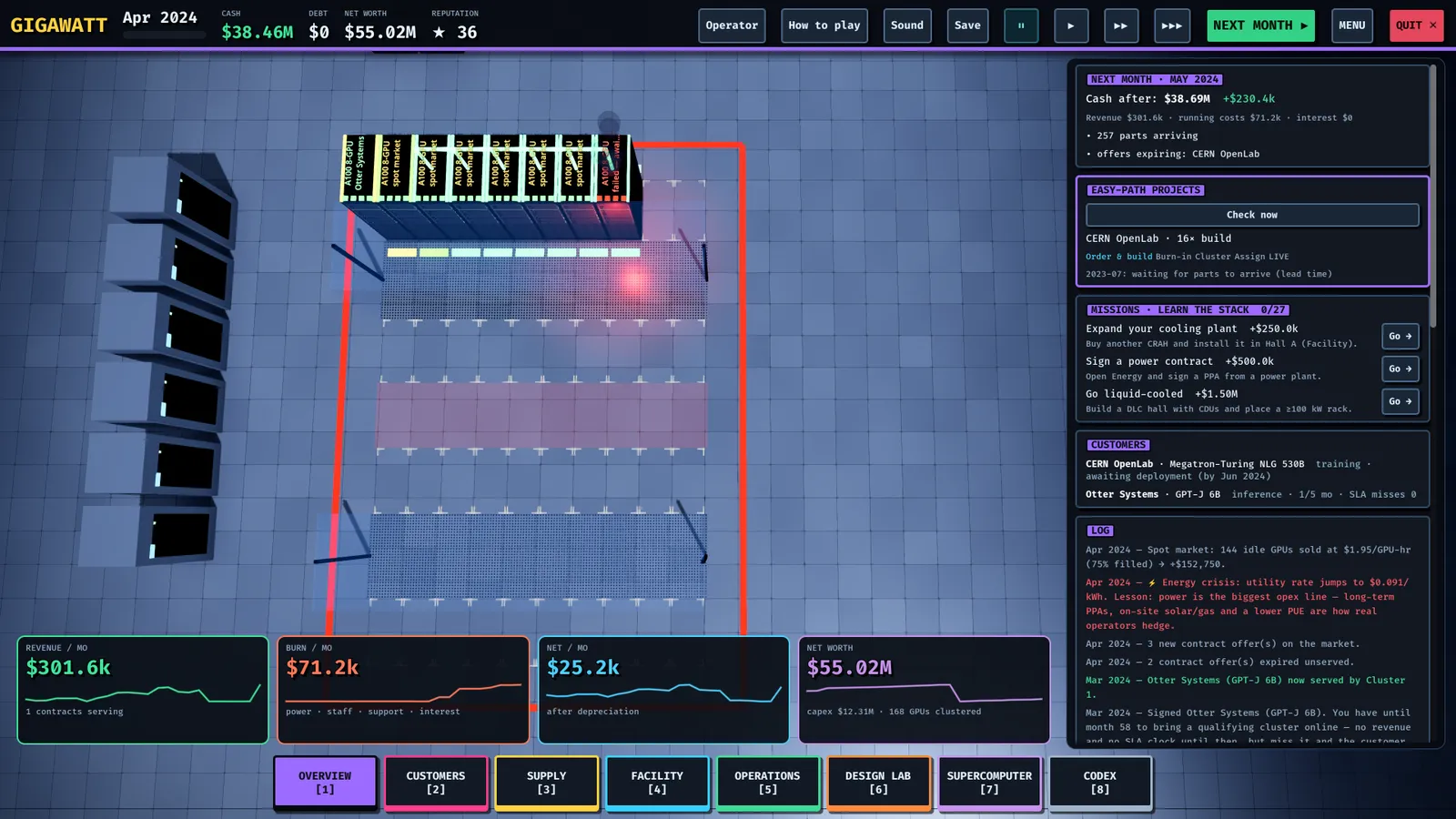 690+ real parts
live thermal state
train & serve
Pick a platform or build a tray and rack from individual CPUs, DIMMs, GPUs, NICs and PSUs. The validator tells you what breaks.
Real lead times, allocation caps, vendor relationships and volume discounts. Buy DIY, an OEM rack, or a turnkey one.
Power, cooling, floor loading, internet circuits. Air, rear-door, direct-liquid or immersion. Overcommit and racks trip.
Training customers rent a coherent cluster by the GPU-hour. Inference customers pay per million tokens. Miss the SLA and they leave.
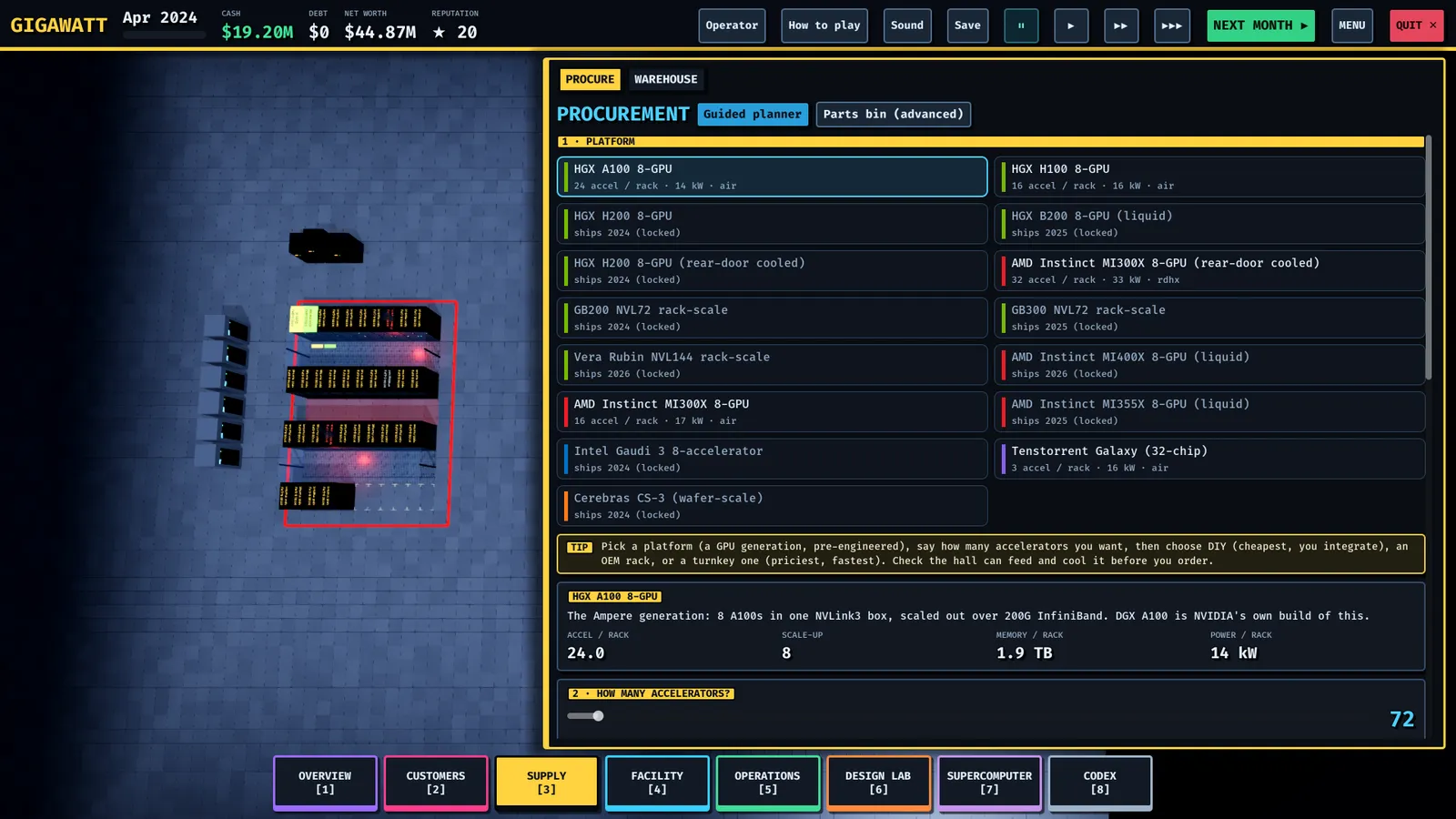
A guided planner (platform → how many → who builds it) on top of a full parts bin. Specs, street prices that drift with the AI boom, lead times that stretch when demand spikes.
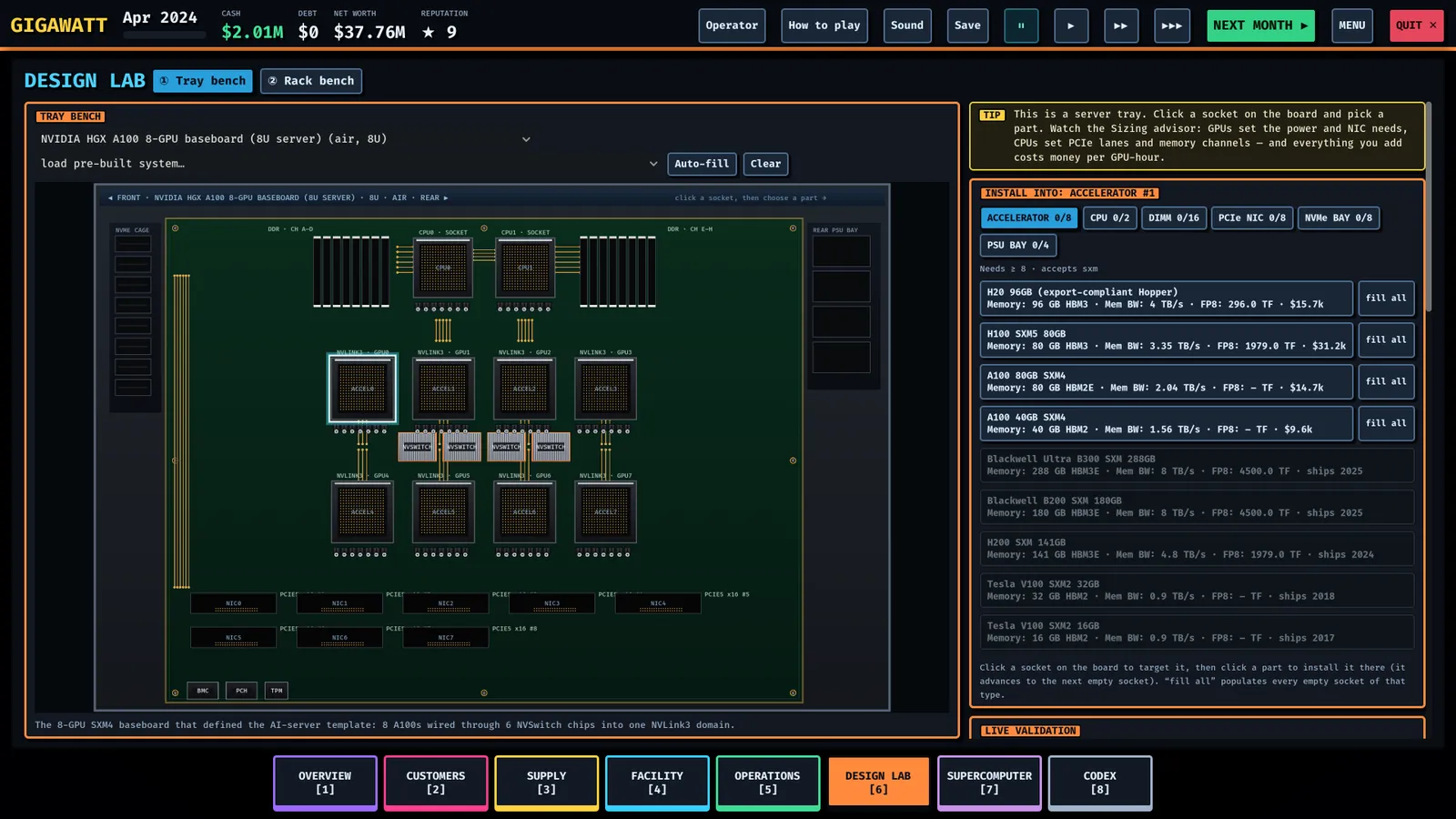
A tray bench with sockets, DIMM banks, GPU baseboards, NICs, NVMe and PSUs, plus a 42U rack elevation. Live validation and a five-year cost advisor.
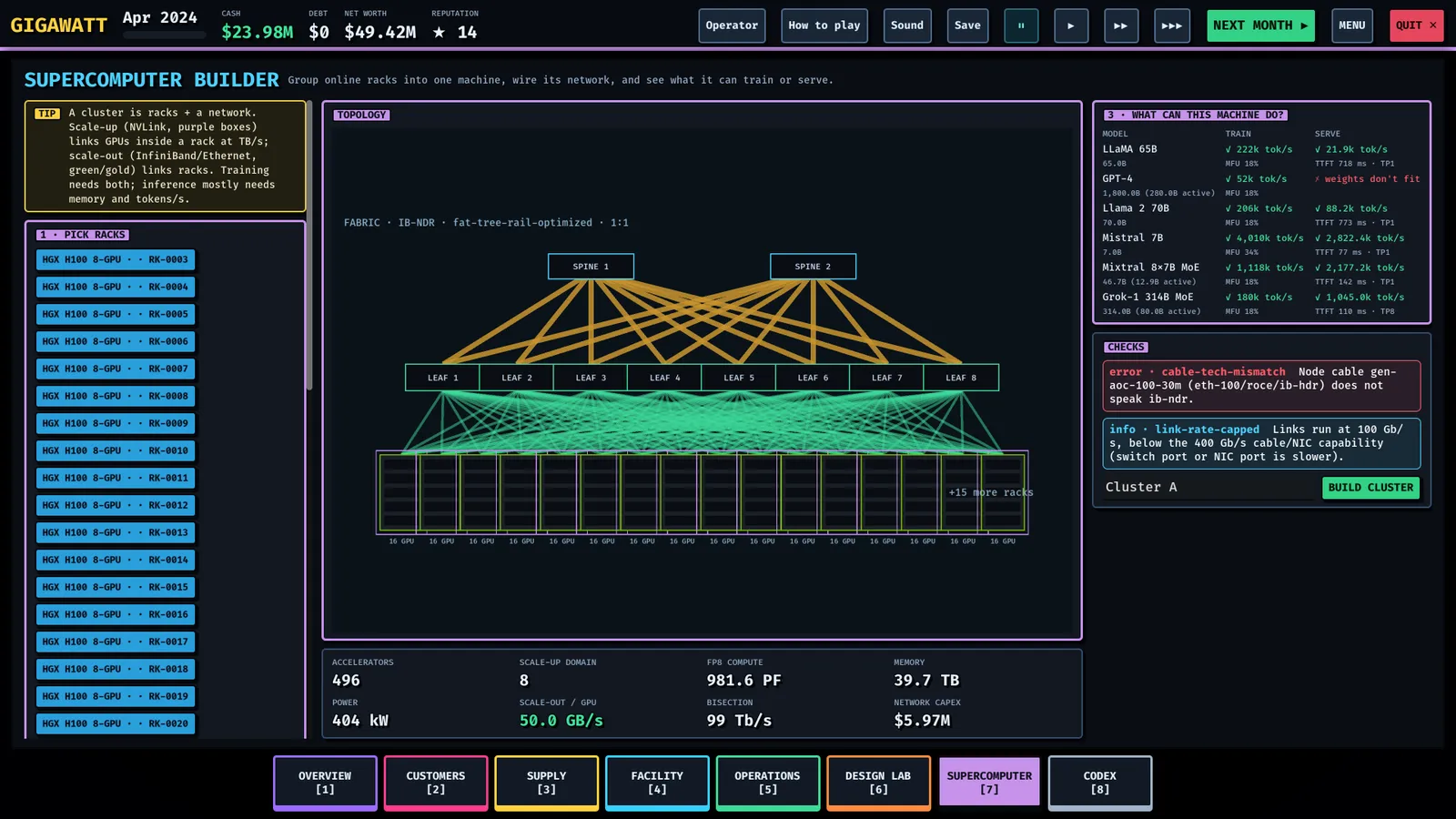
Group racks into one machine, auto-design the fabric or hand-tune it, and see what it can train or serve: per-model tokens per second, MFU and time to first token.
Offers show a live fit verdict and exactly what you still need to buy. Hit Easy Path and the game orders, installs, deploys and assigns for you as parts arrive. Good service earns renewals.
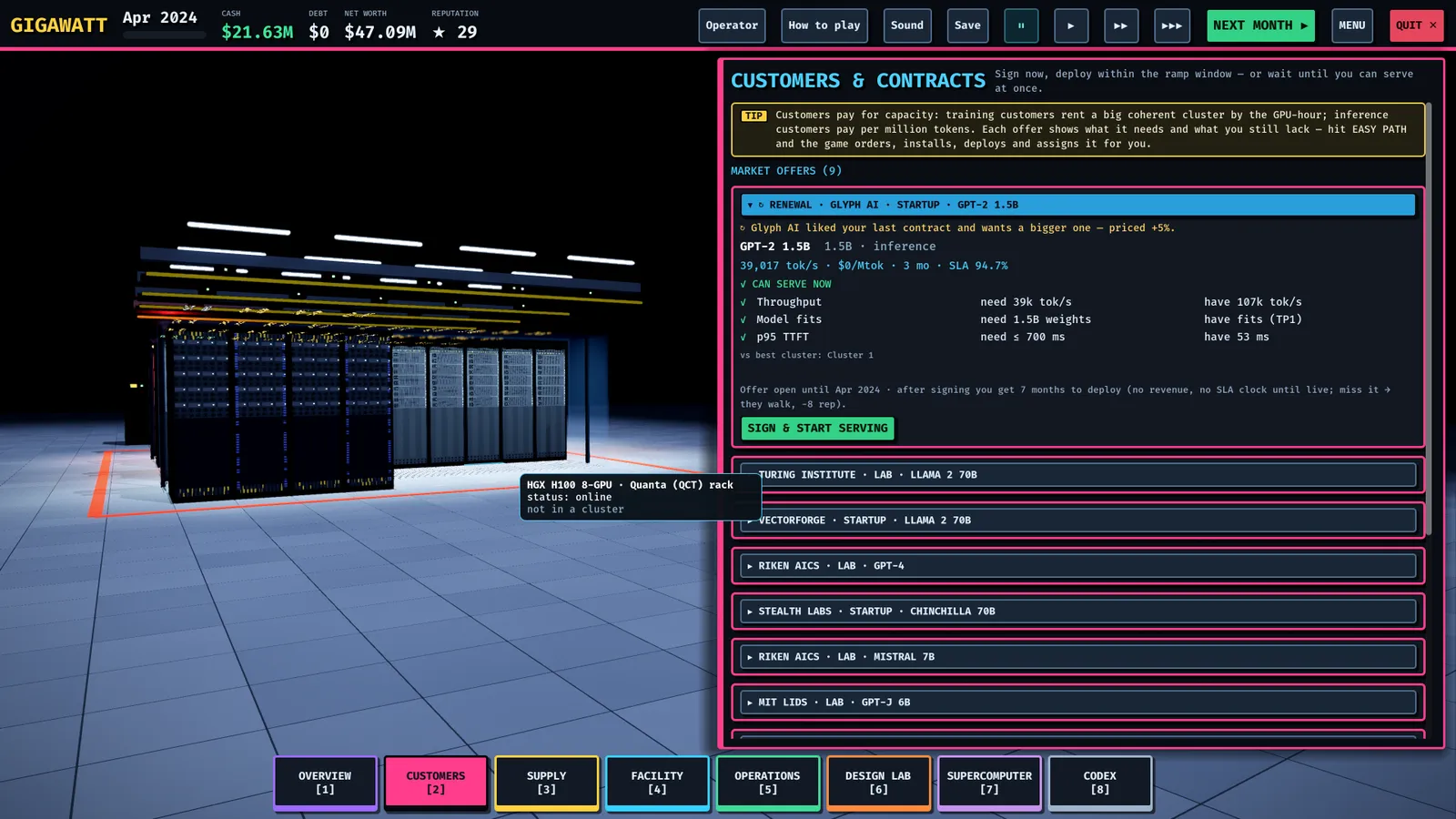
Staffing scales with racks, liquid cooling and fabric size. Hardware loses value every year and every GPU generation. Know when to replace a rack and when to ride it out.
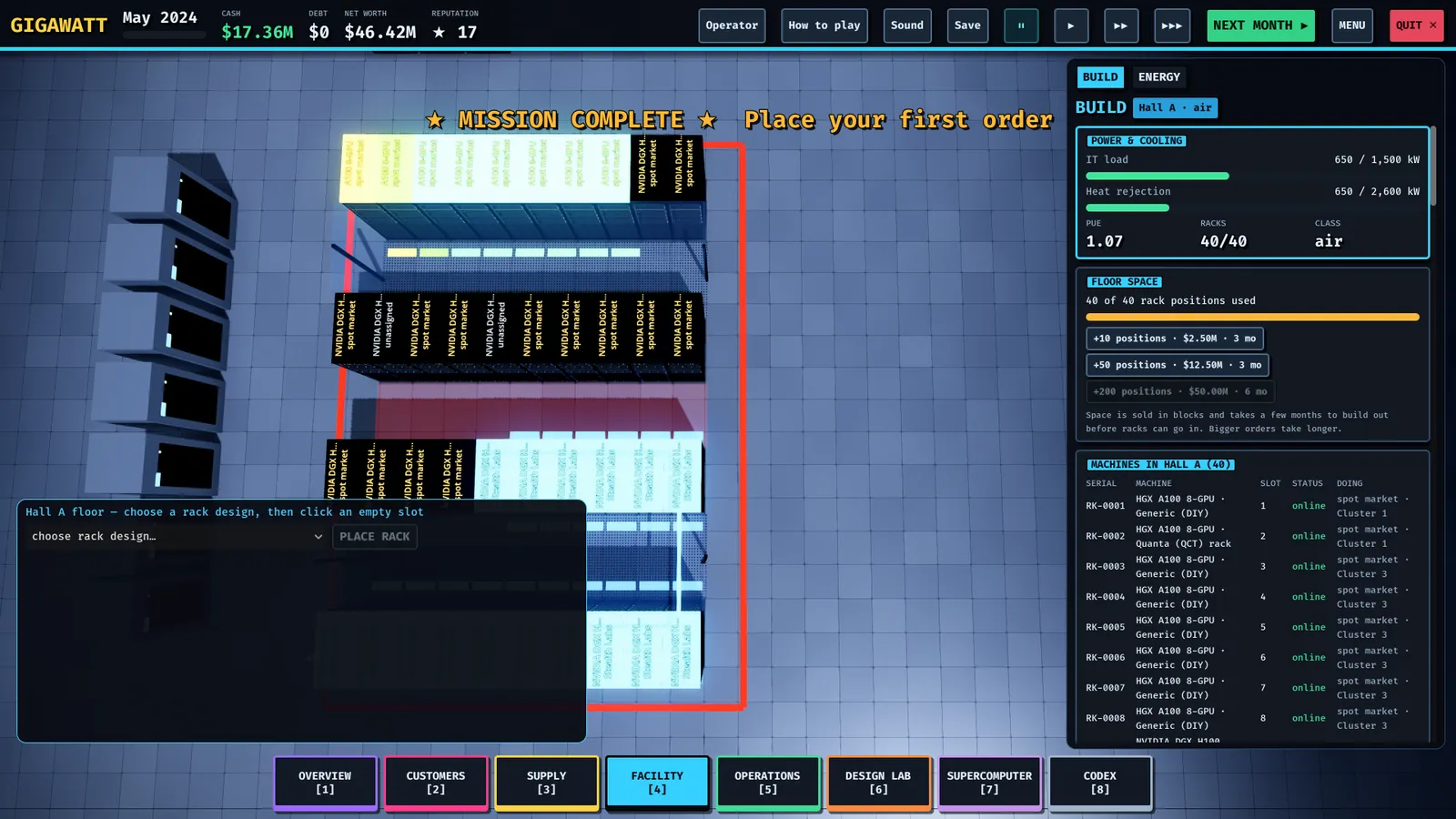
A back-of-the-envelope version of the question the game asks you every month. Rack powers are rounded vendor figures; the game computes them from the exact parts you choose.
Full controller support: D-pad navigates every drawer, sticks fly the camera, and the UI scales up on small screens. A Steam release is planned.
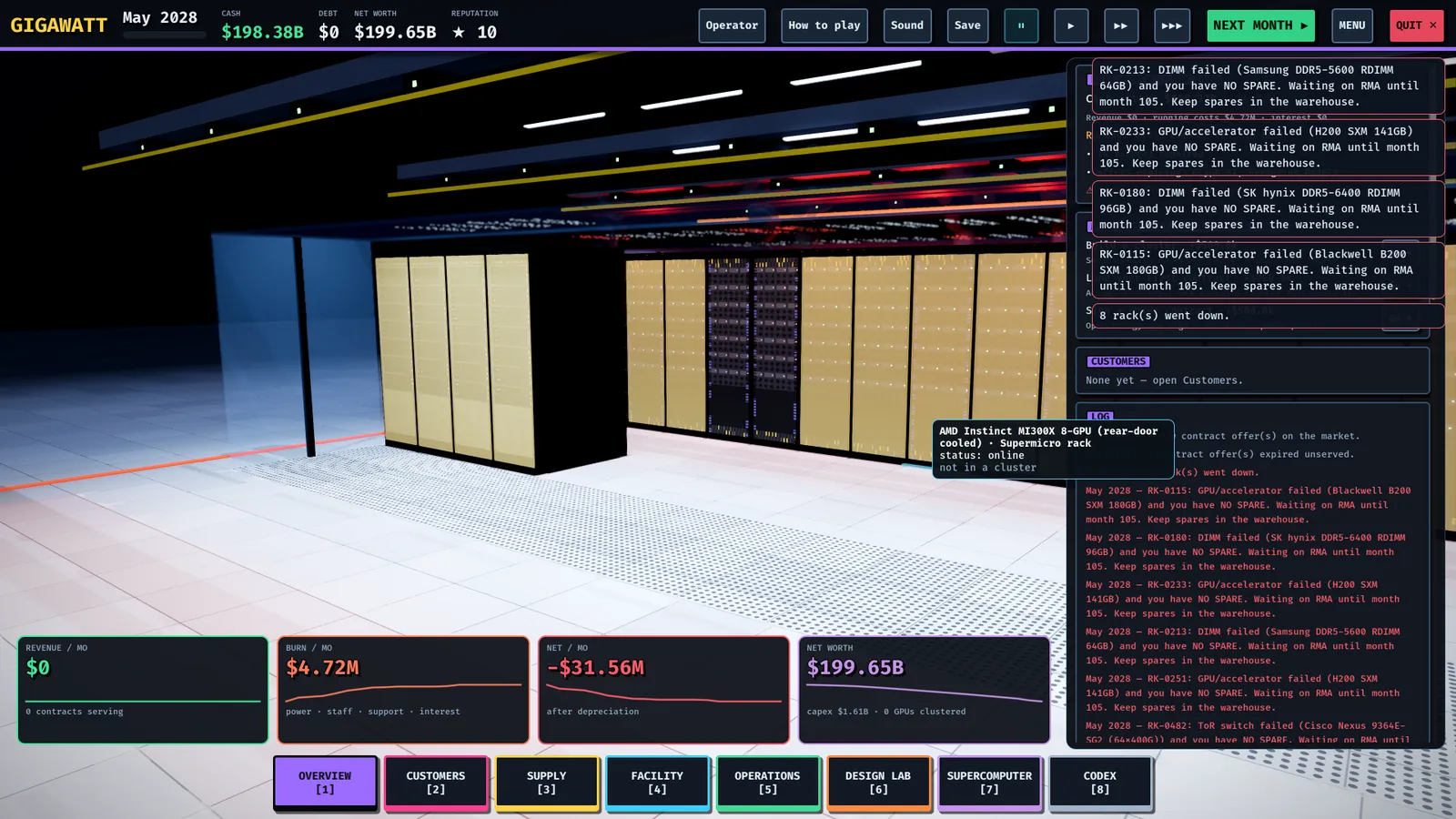
The monthly tick is an ordered pipeline of systems. Golden trajectory tests pin full campaigns bit for bit.
Six personas (idle, random, operator, tycoon, cautious, spot-only) play full 97-month campaigns and check whole-state invariants every month.
The engine exposes a step/reset interface with a Python wrapper, so agents can learn to run a datacenter.
Loading the latest release…
Builds are unsigned, so your OS will warn you the first time. Each release lists SHA-256 checksums. Everything is built by GitHub Actions from the public source.